fbpx

Camp cabin


At Swift Nature Camp we believe the camp community can teach our children valuable lessons that stay with them long after their days at camp. Dr. Cris Thurber agrees, here are his thoughts on how children can be challenged to think and live differently.


Conflict, Camp, and World Peace


Conversations online and off have focused recently on stopping violence and conflict. From Ferguson to France, people have discussed, debated, and demonstrated more passionately than ever. When human rights are in question, we speak of “ridding,” “routing,” “crushing,” and “eliminating” the scourges of terrorism, extremism, and racism.

Forgotten has been any consideration of coaching people through conflict. And although the civilized world agrees that peace is paramount, it is an oversimplification to believe that extrication from cultural blights requires a single, destructive method. Or simple resolve. As much as any snuff metaphor has appeal, the path to peace requires construction, not destruction. We must renew our commitment to teach empathy, emotion regulation, and forgiveness. Summer camp is the best way to do that.

More than 150 years ago, summer camps were founded in this country by progressive educators who clearly saw the limitations of the traditional classroom. They created a complementary institution to fill in the gaps. To do that, they brought young people from inside to outside; from sitting and listening to running and playing; from memorizing to creating; and from dependence to inter-dependence.


Today, research has validated the intuition of camp’s founders and the hope of all parents who have laid down their hard-earned money for an experience that is ostensibly recreational: Young people grow in self-reliance, social skills, physical and thinking skills, and sense of adventure faster at camp than at school. And now it’s time to apply camp’s power to accelerate positive youth development to the worldwide problem of violence and conflict. Ironically, that process begins by embracing the notions that disagreement and fear of differences are human.


Endowed with an understanding of our nature, camps have shed the zero tolerance policies that have failed at schools and have begun training their staff to recognize bullying, intolerance, poor sportsmanship, and harassment. Then, instead of kicking kids out of camp, these professional youth leaders teach new skills to campers and praise incremental improvements in their behavior.

There will always been some egregious misbehaviors that will get children expelled from camp, but today’s enlightened approach is about recognizing youngsters’ underdeveloped skills and coaching them to win-win outcomes with their peers and caregivers. With compassion and creativity, there are ways for everyone to get their needs met. And just as an addict can abstain from substances when sobriety is reinforcing, so can young people abstain from cruelty when kindness feels so good. There is no such thing as a bully with a secure attachment to a reliable group of friends.

Terrorists justify the elimination of life and liberty—in the form of murder—in the name of an idea. The rest of the civilized world sees the flip side of the same coin: We begin with the ideas of liberty and justice for all and remove it—in the form of imprisonment—only after a crime has been committed. This is a timeless dialectic, but it does not portend our destiny.


Because ideas are so potent, let us further one idea we know works: Transporting young people from home into a beautiful natural setting to join a community of their peers and participate in supervised, unstructured play. High quality camps are both proving grounds and laboratories for civilization. The campers learn how to get along and the counselors learn how to coach the kids toward kind behavior. Only when they are combined can a classroom education and a summer camp experience tip the current cultural imbalance toward durable world peace. It’s time to sign up.


Dr. Christopher Thurber is a clinical psychologist and former chair of the American Camp Association’s Committee for Applied Research & Evaluation. He is the co-creator of ExpertOnlineTraining.com and serves on the faculty of Phillips Exeter Academy. He can be reached at: This email address is being protected from spambots. You need JavaScript enabled to view it.

As summer camp owners, educators and parents, For the past 20 plus years we have dedicated ourselves to continuing our education in parenting and child development. What we have found is often the research we do to help counselors and camp kids becomes amazingly valuable in raising our own child. We gain our knowledge not only from reading but we attend conferences and workshops and constantly look online. Our goal is to be a part of your child's personal development not only during times of camp but all year round. This parent resource center is designed to be a place to share information about different ideas in raising children. So please feel free to read the articles and post comments or let us know of resources you may have found to share with others that have been extremely helpful in raising your children.


Websites 


Books


We always have a book on our night stand that is dedicated to helping us live a better life and be better at raising our children.  Often one of these becomes the focus of our staff training at camp. We have added a simple link to Amazon so you can read more about each book. 


Parents today are all asking the same question: What will it take for my child to succeed in todays world?


Despite all the technology we live in, I was suprised to see that Americans still realize the need for the soft skills. The skills that are not taught in school. Sure, we need to stay competitiive with  science and math skills as the world becomes smaller and more competitive. Yet, we all see the need for the  less tangible skills in our kids, such as teamwork, logic and basic communication skills.

The Pew Research Center recently asked a sample of adults to select among a list of 10 skills: “Regardless of whether or not you think these skills are good to have, which ones do you think are most important for children to get ahead in the world today?”

The answer was clear. Across the board, more respondents said communication skills were most important, followed by reading, math, teamwork, writing and logic. Science fell somewhere in the middle, with more than half of Americans saying it was important.

benefits of overnight cmap

So how does Summer Camp fit in to all this? We teach soft skills. We help children figure out what works and what dosent when dealing with peers. Teamwork prevades all of camp life. Children become independent and figure things out for themselves. Camp is so much more than just fun, games and songs outside. it is one of the best training grounds to ensure future success. Michael Eisner of Disney,  said it best,"But oh, the lessons I learned on those camp canoe trips. We could never survive the first day if we did not practice teamwork, show initiative, handle adversity, listen well and not least importantly, maintain a sence of humor:" 


A few years ago I was at a conference for summer camp professionals and we had a guest speaker, a 15 year old boy. He loved his camp experiences and had hoped to return the up coming summer to become a counselor in training where he would assist in the supervision of the younger children. However, a few weeks earlier he had been told by his High School Guidance Counselor that he was now of the age that he needed to begin thinking about resume building and Summer Camp clearly was not on the list. The boy and his family were devastated but decided to make plans to follow the given advice. I had only wish that I  had the below CNBC Article for the family. All guidance counselors need to read the below article and encourage children to keep learning at summer camp

Summer camp may improve college admissions odds

CNBC logo.svg | CNBC -Sunday, 27 Apr 2014 | 10:00 AM 


How you spend your summer vacation isn't just fodder for first-day-back-in-school essays. It could provide a boost on college or job applications—especially if you went to camp.

Colleges have been getting more selective in recent years. In 2012, the average four-year college accepted 63.9 percent of applicants, down from 69.6 percent in 2003, according to the National Association for College Admission Counseling. Many are even more selective. This year, Yale University accepted just 6.26 percent of applicants, down from 6.27 percent a year ago and 11 percent in 2005, according to educational consulting company IvyWise. Cornell University accepted 14 percent, versus 31 percent in 2005.

Grades and standardized test scores are still the top factor for admission, but educational counselors say colleges are starting to take a harder look at extracurricular activities, particularly those over summer vacation. "Parents assume their kids need to be even more competitive on grades," said Eric Greenberg, founder and director of education consulting firm Greenberg Educational Group. "What has happened, ironically, is the opposite."

To colleges, summertime is like the hiatus between jobs a prospective employer would ask about, said Mark Kantrowitz, senior vice president and publisher at Edvisors Network. "Colleges want to understand, what have you been doing with yourself?" he said. "What happened during that gap?" The answer can be telling of what a student will do on campus.

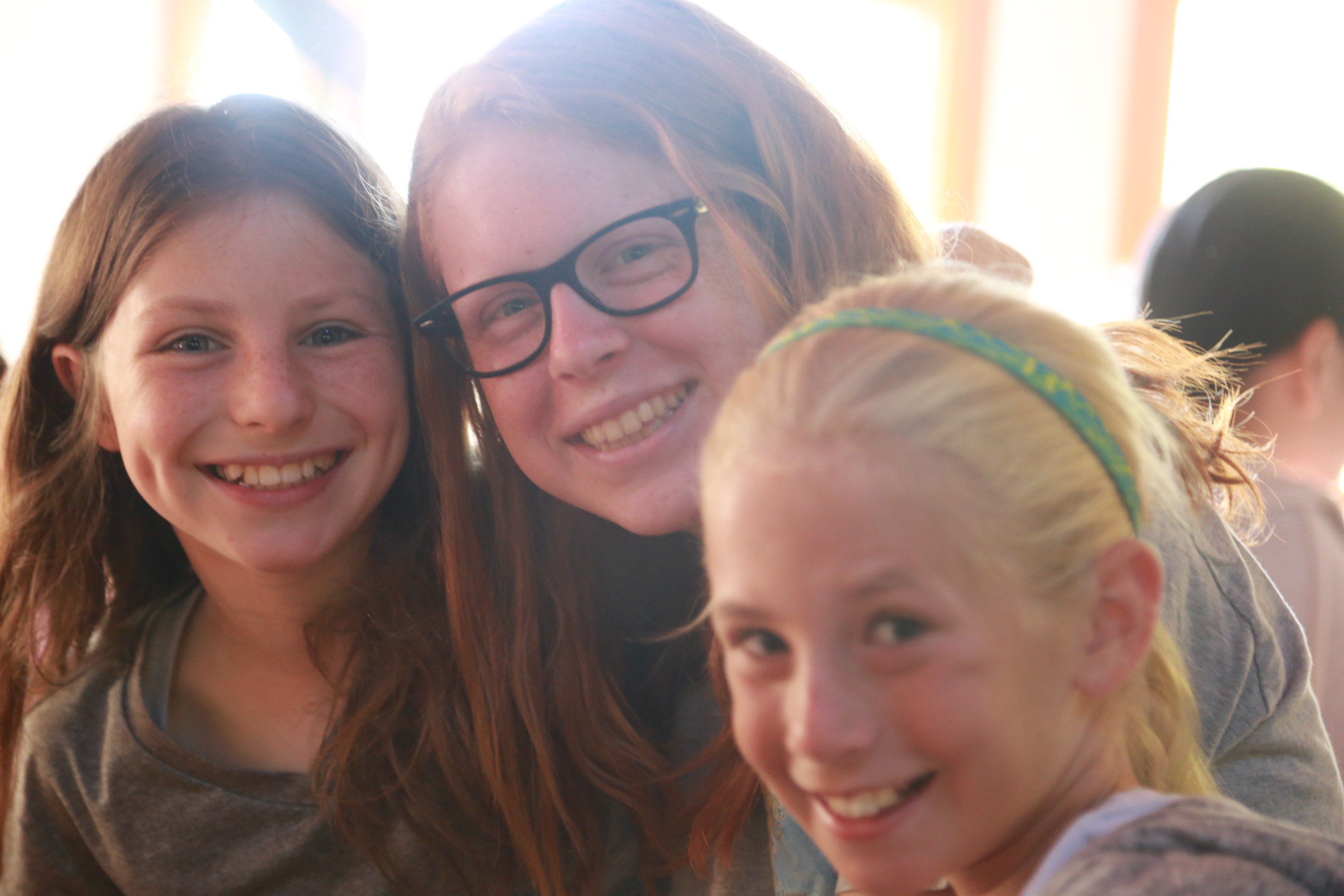
Campers: Sylv, Hannah and Talia.
Source: Talia Rodwin,
Campers: Sylv, Hannah and Talia.

Parents shouldn't immediately race for the nearest camp sign-up sheet. While there are surely college admissions officers with fond memories of lake swims and archery, the camp experience that is more likely to stand out is a specialized one that speaks to a student's interests, experts say. Summers at soccer camp can help show a would-be college athlete's dedication, for example, while theater camp can be an edge for someone applying to the acting program—especially if the high school's drama program is so-so (or nonexistent). 

Focused camps aren't that difficult to find. Half of day camps have some kind of academic activities or areas of study, and one-third offer a STEM (i.e., science, technology, engineering or math) program, according to the American Camp Association. 

"By being stronger on the extracurricular activities, you can actually make up somewhat for weaknesses academically," Kantrowitz said. It's no slam dunk, though. "Not everyone is going to yield a benefit, but it's something that distinguishes you," he said. (Considering, however, that some camps can cost upwards of $1,000 per week, it's worth pointing out that extra experience in a student's areas of interest could just as easily come from a summer course at a local college, volunteer experiences or work, he said.) 

Steven Infanti, associate vice president for admissions at Harrisburg University of Science and Technology, said a STEM camp experience is something that makes him take a closer look at a student's application. "When I look at an applicant who has a 2.5 [GPA], which would be kind of a borderline admit for us, but I see on his application, I participate in this camp…that shows a lot of initiative and someone who has a passion," he said. 

For higher-achievers, relevant camp experience may put them in the running for the university's fellowship program, which pairs 15 incoming freshmen with faculty for research projects, among other advantages. 

Colleges may also find longer camp relationships interesting, even if the camp isn't academically focused. "The regular camper who becomes a counselor is a good type of continuity," Greenberg said. That kind of camp experience can indicate positive qualities such as leadership, resilience and good social skills, he said. 

That's the kind of story Oberlin College freshman Talia Rodwin expressed in her application essay. Rodwin, 19, has been attending Habon Dror Camp Moshava in Silver Spring, Md., since 2006 and plans to return this summer for her second year as a counselor. (The youth movement camp emphasizes sharing, leadership and communal responsibility.) "I wrote about my camp experiences and community," she said. "I explained how I think of myself as a community builder…and I think that had an impact." 

Simon Solis-Cohen (R), whose camp experience led him to become a chef.
Source: Simon Solis-Cohen
Simon Solis-Cohen (R), whose camp experience led him to become a chef.

While camp as an application booster isn't a guarantee, it could have other benefits for a college-bound student. Overnight camps can offer a taste of independent living (or at least, living away from mom and dad). The right camp could even help solidify a career path, reducing the chance of a five- or six-year stint at a four-year college while an undeclared student explores options. 

"If you go to summer camp and you decide because of the camp that this is what you want to be, you're going to be much more focused as a student," Kantrowitz said. 

When he was in middle school, Simon Solis-Cohen, now 23, signed up for a magic camp through Julian Krinsky Camps & Programs in Pennsylvania. He liked it so much that the next year, he tried one of the group's business camps. Then, in the summer leading up to his freshman year of high school, he discovered cooking camp. "It really opened my eyes," Solis-Cohen said. 

He was so enamored with cooking that he started working weekends during the school year at the camp chef-instructor's restaurant, then attended college at the Culinary Institute of the America. "I ended up using this as my launching pad," said Solis-Cohen, who is currently with Grgich Hills Estate in Rutherford, Calif., after a stint at renowned Napa Valley restaurant The French Laundry. 

As Solis-Cohen discovered, camp can even be a kick-starter for jobs down the line—provided the experience backs up other bona-fides. "Camp is about the social experience of working with other young people in a group setting that's outside your comfort zone," said Chad Oakley, president and chief operating officer of executive search firm Charles Aris, Inc. "That in itself is 50 percent of success in a business environment." 

But it's no job shoe-in. "You might get the interview because you went to math camp, but you'd actually get the job because of your ability to interface with people during the interview," said Oakley. 

Showcasing a camp experience during the college admissions process can be done in a handful of ways. It might be listed as extra-curricular activities on the college application, or a particularly meaningful experiences worked into the essay portion. 

"If you had a transformative experience at the summer camp or a big impact on others, that tells them more about who you are as an individual, especially if you can write about how it set you in a particular direction," Kantrowitz said. "If something is of interest to you, you're more likely to write a passionate essay." 

Favorite counselors or camp directors should also be considered for letters of recommendation. "Relatively few students submit letters from outside [school] or that are job-related," said Greenberg. "That can be enormously valuable." 

team9

WITHOUT THE COMFORTS

BY BEVERLY PLUMMER
Reprinted from the 1965 Chicago Tribune, Camp Minocqua  for Boys is featured in the article and is the summer camp that Jeff Lorenz  is an alumni of  from 1966-1972. He went on to found Swift Nature Camp in 1997.

Television, telephones, and mother-love are all great things. In the winter, of course, but next summer, more than 4 million school age youngsters will trade them for tents, rain, poison Ivy and unforgettable times,

IT GETS COLDER and colder. The rain comes down like the sky is broken. The tent leaks all night and breakfast is bread and rain water eaten under the picnic table.

Is this "Ah, Wilderness!" or "Aaarg, Wilderness!"? Only the boy or girl scrunched damply under the table can tell you. But chances are [even tho it had to be said thru chat- tering teeth] he d say it was GREAT! For this wet, cold, shivering youngster is one of 4 million school-age American children who look forward ea- to camp every summer. Why should a child be so anx- ious to go to camp that he s willing to go without six months' allowance to help foot the bill? Or get up at a snowy 5:30 a. m. to deliver the morn- ing papers so he can buy a new snorkel for camp?

It's not the creature comforts he s seeking-that s for sure. For comforts such as television, telephones, and five-course dinners are better provided at home than on a 100-acre tract of trees and bushes.

Actually what this child is seeking, even if he s not con- aware of it, is a sense of adventure. A chance to be a conqueror rather than a spectator. An opportunity to create

his own security in a strange atmosphere. And where, in to- day s chrome-plated world, can a child find such an opportunity except in the wilderness?

As an American, he still has something of the early pioneer in his bones-the pioneer who slew his own dinner, stitched up his britches, and then fought off the enemy before he went to bed.

A note from a city-bred 14- year-old to his parents last year states proudly, "Besides clearing three campsites out of the bush, setting up a compass course, and assisting the surveyor map the boundary lines of camp, we got to help skin a 125-pound bear and cut logs for a new kitchen floor." This glowing letter was written by a lad who lived 10 stories up in a plush apartment where a maid laid out his clothing every morning!

There have been camps of one kind or another almost from the beginning of America -even the first settlers were campers of a sort The first organized camps began to appear on the east coast as early as the 1860s, but it wasn't until the very late iBO0s that camping grabbed a really firm foothold for itself. It was evidently firm enough, for today there are more than 13,500 organized camps scattered thruout the United States.

The first organized camp in the midwest was started by a young doctor. [just graduated from Northwestern university medical school] following the worst typhoid fever epidemic Chicago has ever known. Dr. John Perley Sprague had been raised in the lumbering country of Maine and had never quite got used to the ways of the city. It bothered him that so many children were growing up with no intimate knowledge of nature, so in April, 1903, he set out for upper Wisconsin be- fore the ice was even out of the rivers and lakes to find a spot to set up a camp.

What he finally settled on was a point on Lake Toma- hawk near Minocqua, which still stands today and is still in operation under the direction of his daughter, Helen, and son-in-law, Jack Broomell. Boys who go to Camp Minocqua today board the train at Chicago s North Western station

and arrive at camp about eight. hours later.

The 15 campers who went north with Doctor Sprague in 1903 were not so fortunate; but when this story is told, many a boy declares he'd give his right arm to have been in that first group.

"We took a train from Chicago," Doctor Sprague wrote CAMP For City-Dwellers: A Place in the Open In camp craft classes such as bowl-making, boys can create with their own hands.

in his notes, "and when we woke up in the morning, we had only gone about 200 miles be- cause a bridge had washed out. It seems there was a lot of flooding that year. There was no diner on the train and they took the sleeper off, too. During the afternoon they fixed up the bridge and we went on, only to be stopped again when the tracks disappeared under water at the Wisconsin river. But they decided to try it and we got across and kept right on going to Mosinee, where the tracks were under water again. And we had to stop once more."

At 4 the next morning, Doc- tor Sprague got everybody off the train and they got up a game of baseball in the grass beside the tracks. Hungry to the desperation point, they finally found a boarding house cook who fixed breakfast for them for a hatful of coins that had been collected. The rest of the trip was made partly by box car and partly by hand-car.

"Finally," Doctor Sprague said, "an engine came down from the north and picked us up and on the third day we finally got there."

Camp Minocqua is much the same today in spirit as it was 60 years ago; the ultimate aim of its directors always has been to provide the child with a natural atmosphere in which he can grow in all directions. This is the aim of all good camps today.

"There was no 'baby-sitting' in those days," Helen Broomell says. "It was primarily an opportunity for boys to spend the summer out-of-doors . . . it wasn't even supposed to be a 'character-building' experience except as the good influence of the men rubbed off on. the boys."

Camp Minocquafor Boys would be classified today as an "all-around" camp with a good solid emphasis on individual growth, altho the program includes a liberal choice of everything you might consider important to camping: riding, sailing, crafts, archery, etc.

There are so many camps today which, altho they maintain social orientation as the ultimate goal, are highly specialized . A few examples: folk- singing camps, language-of- your-choice camps, all-sports camps where a child chooses one major and one minor sport and works on proficiency in these areas all summer long. There are pioneer camps, camps for the psychologically disturbed, riding camps, and tours-of-Israel camps.

The rivalry between different types of camps is much like the rivalry between competing high schools. One group of boys came back from a visit to a neighboring camp with these words of disgust: "It's a chicken camp. Everybody wore identical T-shirts, and there were these 'Gung ho' loud speakers that blasted out instructions all day long - just like in the movies. All the one had to do was sit on their duffs while 'big brother' told them what to do over the loud speaker."


CAMP-The Counselor Must Love Children. Nature was like downtown New York. Everything was paved! You couldn't get dirty if you want- ed to."

For some children, being able to get good and dirty with a bunch of other guys is reason enough to go to camp. They come from big cities where they have no close companions, even in their own family group; often they don't even sit down to dinner with their parents, but eat in the kitchen with the maid.

This was a real revelation to one of the foreign-exchange counselors who came to this country thru the efforts of the Committee for Friendly Relations Among Foreign Students. He was surprised at the bad table manners of some of the boys from wealthy families. He referred to the children in his cabin as "small gangsters," but this was a term of real affection for he was completely charmed by their warmth and maturity.

"An American camper is not as well disciplined as the Swedes," the counselor later observed. "He is less bashful and somewhat more matured than his Swedish mate. But you very soon get acquainted with him and after two hours he declares he likes or hates you more than anybody in the world."

He was judging only boys from a small segment of American life, however, because unless a child has a wealthy uncle or well-to-do parents, he can't afford a summer at

a private camp. Rates begin at about $575 and go on up.

Private camps are only a small part of the organized camp picture, tho. Only 3,000 of the nation s 13,500 organized camps are privately owned and run. Most of the rest are agency and day camps. A "season" is more flexible at these camps, running from one day to several weeks and costing as little as $15 per week.

Many find it hard to understand why anyone would choose to work at a summer camp, but the conclusion can only be heartening to any parent considering sending his child.

Because the pay is poor, the hours are bad, and working conditions sometimes unfavorable [such as an "overnight" in a leaky tent], it can only be assumed that counselors take these jobs out of a love for children and nature.

One of the toughest jobs a director has is selecting good counselors. At one time these young people were chosen because they possessed some special skill, but today directors seek well-rounded, emotionally mature persons. In addition to counselors, the director hires cooks, kitchen boys, stable boys, a camp-mother, a doctor and/ or a nurse. Each staff member is selected with infinite care, because it takes a special kind of person to be able to live so intimately with so many children or young adults for such a length of time.

WHAT TO LOOK FOR IN A CAMP

A PARENT interested in finding the best camp for his child should consider the following points:

1. A good ratio is one counselor for every eight campers; an ideal ratio is one to four.

2. A good director will ask for a personal history of your child. Not so he doesn't, forget her, because if he doesn't feel he needs to know such things as the fact that Sally still wets her bed or is afraid of the dark, he isn't very interested in her.

3. A good camp has a rigid code of safety and health, but a flexible and adaptable daily program of recreation.

4. Fees alone do not make a camp bad or good, and in no way indicate what a camp is really like.

End of article

Today, Swift Nature Camp has progressed with the times enhancing a child's personal growth while at camp,   Camp Minocqua is still in the heart of Director Jeff Lorenz and often is being recreated at camp in the camp for the 21st century.

THE HYBRID MIND: The More High-Tech Education Becomes, The More Nature Our Children Need


I once met an instructor who trained young people to become the pilots of cruise ships. He described the two kinds of students he encounters. One kind grew up mainly indoors, spending hours playing video games and working on computers. These students are quick to learn the ship’s electronics, a useful talent, the instructor explained. The other kind of student grew up spending a lot of time outdoors, often in nature. They, too, have a talent. “They actually know where the ship is.”

Look2

He wasn’t being cute. Recent studies of the human senses back that statement up. “We need people who have both ways of knowing the world,” he added.

Currently, the force of economics is on the side of technology and standardized efficiency.

Optimistic researchers suggest that multitasking is creating the smartest generation yet, freed from limitations of geography, weather, and distance—pesky inconveniences of the physical world.

Others are skeptical, if not hostile to technology. In his book The Dumbest Generation, Mark Bauerlein, a professor at Emory University, reels out studies comparing this generation of students with prior generations, reporting “they don’t know any more history or civics, economics or science, literature or current events”— despite all that available information. Other researchers believe that people who experience too much technology in their formative years experience stunted development of the frontal lobe, “ultimately freezing them in teen brain mode,” as Maclean’s magazine put it.

Here’s a third possibility, what I call the hybrid mind. The ultimate multitasking is to live simultaneously in both the digital and physical worlds, using computers to maximize our powers to process intellectual data and natural environments to ignite our senses and accelerate our ability to learn and feel—combining the resurfaced “primitive” powers of our ancestors with the digital speed of our teenagers.

Want Students to Learn? Ignite the senses now

Scientists who study human perception no longer assume we have only five senses: taste, touch, smell, sight, and hearing. The number now ranges from a conservative 10 to as many as 30, including blood-sugar levels, empty stomach, thirst, and proprio­ception (awareness of our body’s position in space).

Ever wonder why you have two nostrils? Researchers at the University of California at Berkeley did. They fitted undergraduates with taped-over goggles, earmuffs, and work gloves to block other senses, then set them loose in a field. Most of the students could follow a 30-foot-long trail of chocolate perfume and even changed direction precisely where the invisible path took a turn.

The subjects were able to smell better with two functioning nostrils, which researchers likened to hearing in stereo. And they found themselves zigzagging, a technique employed by dogs as they track. “We found that not only are humans capable of scent tracking,” said study researcher Noam Sobel, “but they spontaneously mimic the tracking pattern of [other] mammals.”

In 2009, researchers at Madrid’s University of Alcalá de Henares showed how people, like bats, could identify objects without needing to see them, through the echoes of human tongue clicks. According to the lead researcher, echoes are also perceived through vibrations in ears, tongue, and bones—a refined sense learned through trial and error by some blind people and even sighted individuals. It’s all about hearing a world that exists beyond what we normally mistake for silence.

What else can we do that we’ve forgotten?

The U.S. military has studied how some soldiers seem to be able to use their latent senses to detect roadside bombs and other hazards. The 18-month study of 800 military personnel found that the best bomb spotters were rural people—those who’d grown up in the woods hunting turkey or deer—as well as those from tough urban neighborhoods, where it’s equally important to be alert.

“They just seemed to pick up things much better,” reported Army Sergeant Major Todd Burnett, who worked on the study for the Pentagon’s Joint Improvised Explosive Device Defeat Organization. “They know how to look at the entire environment.” And the other enlistees, the ones who’d spent more time with Game Boys or at the mall? They didn’t do so well. As Burnett put it, they were focused on the proverbial “screen rather than the whole surrounding.”

The explanation may be partly physiological. Australian researchers suggest that the troubling increase in nearsightedness is linked to young people spending less time outdoors, where eyes must focus at longer distances. But more is probably going on here. Good vision, acute hearing, an attuned sense of smell, spatial awareness—all of these abilities could be operating simultaneously. This natural advantage offers practical applications. One is an increased ability to learn; another is an enhanced capability to avoid danger. Still another, perhaps the most important, is the measurement-defying ability to more fully engage in life.

Today, students (and the rest of us) who work and learn in a dominating digital environment expend enormous energy to block out many of these senses, in order to focus narrowly on the screen in front of the eyes. That’s the very definition of being less alive.

listen


Who among us wants to be less alive? What parent wants their child to be less alive?

I believe that a central goal of modern education should be to encourage such flexible thinking, to nurture the hybrid mind — to stimulate both ways of knowing in the world: digital and direct experience.

Screens and Streams: The river of knowing

Research in this area remains a frontier in the academic world, but evidence is growing. Schools that do use outdoor classrooms and other forms of nature-based experiential education report significant student gains in social studies, science, language arts, and math. Students in Finland lead the world in math and science scores; in that country, it’s an article of faith that the best education includes time spent in the classroom — with lots of recess and learning time outdoors.

Children are more likely to invent their own games in green play spaces rather than on flat playgrounds or playing fields. Green play spaces also suit a wider array of students and promote social inclusion, regardless of gender, race, class, or intellectual ability. One study found that so-called at-risk students in week-long outdoor camp settings scored significantly better on science testing than in the typical classroom. At the Human-Environment Research Laboratory at the University of Illinois, researchers have discovered that children as young as 5 show a significant reduction in the symptoms of attention deficit/hyperactivity disorder when they engaged with nature.

Cognitive and behavioral benefits accrue well beyond school boundaries. In inner-city housing projects in Chicago, investigators found that the presence of trees outside apartment buildings were predictors of certain behaviors: less procrastination, better coping skills, greater self-discipline among girls, better social relationships, and less violence. Educators benefit, too. Canadian researchers found that teachers expressed renewed enthusiasm for teaching in schools that engage their students in natural settings.

Maximum learning usually takes place when more of our senses are engaged. Yes, tight digital focus is often needed, but the healthy brain — the learning brain — also needs to pay a different kind of attention, an attention that researchers have called “fascination,” which often happens in more natural settings. This kind of attention restores the parts of the brain fatigued by too much “directed attention.” This is true for students, for teachers, for all of us.


Is education moving in this direction? Some schools are. They’re creating natural play and learning spaces, school gardens; they’re using nearby nature in cities and wilderness beyond them to connect the young to the world of knowledge. Often, they’re incorporating new technologies into these experiences.

But too many school districts are putting all their eggs on one computer chip, while reducing recess, canceling field trips, and demanding that students spend ever more time at their desks, staring at screens.

Few today would question the notion that every person, especially every young person, has a right to access the Internet, whether through a school district, a library, or a city’s public Wi-Fi program. We accept the idea that the divide between the digital haves and have-nots must be closed. But all children also have a right to develop a wider spectrum of their senses and mental abilities, to know the real world, and to be fully alive.

By  on March 30th, 2015 


campfire

Do you know kids & teens looking for a fantastic, good ol' days, totally hip & fun summer adventure that's reasonably priced?

Delighting both girls and boys, Swift Nature Camp has been a favorite childhood experience for my boys each summer since 2003. I trust the directors, I adore the counselors, I appreciate the outside active fun, and I love the gorgeous setting. And, I love that it's cheaper than my daughter's camp! Swimming, canoeing, fishing, tubing, riflery, archery, crafts, camp fires, camping trips, clowning, & good ol' capture the flag in the woods are some of what my kids love about Swift. The break from school kids, family life, and electronics gives them the awesome experience of pursuing new and different activities with fresh, friendly kids that just want to have fun without the drama. Not once in our 12 sessions did I receive a letter from the boys feeling down at camp. In fact, when they came home, they always said they wanted to stay longer next time. I'd love for you to learn more about this camp in Minong, Wisconsin. It has been a key factor in shaping my kids into the people I love today. Check it out.

The above note was taken from a camp families facebook page. At SNC our goal is to be part of your childs development and help your child be the best person they can be and get ready for life filled with self confidence and independance. Please see our other Parent Testimonials.

Like most parents you’re concerned about your child’s academic growth during the long summer break
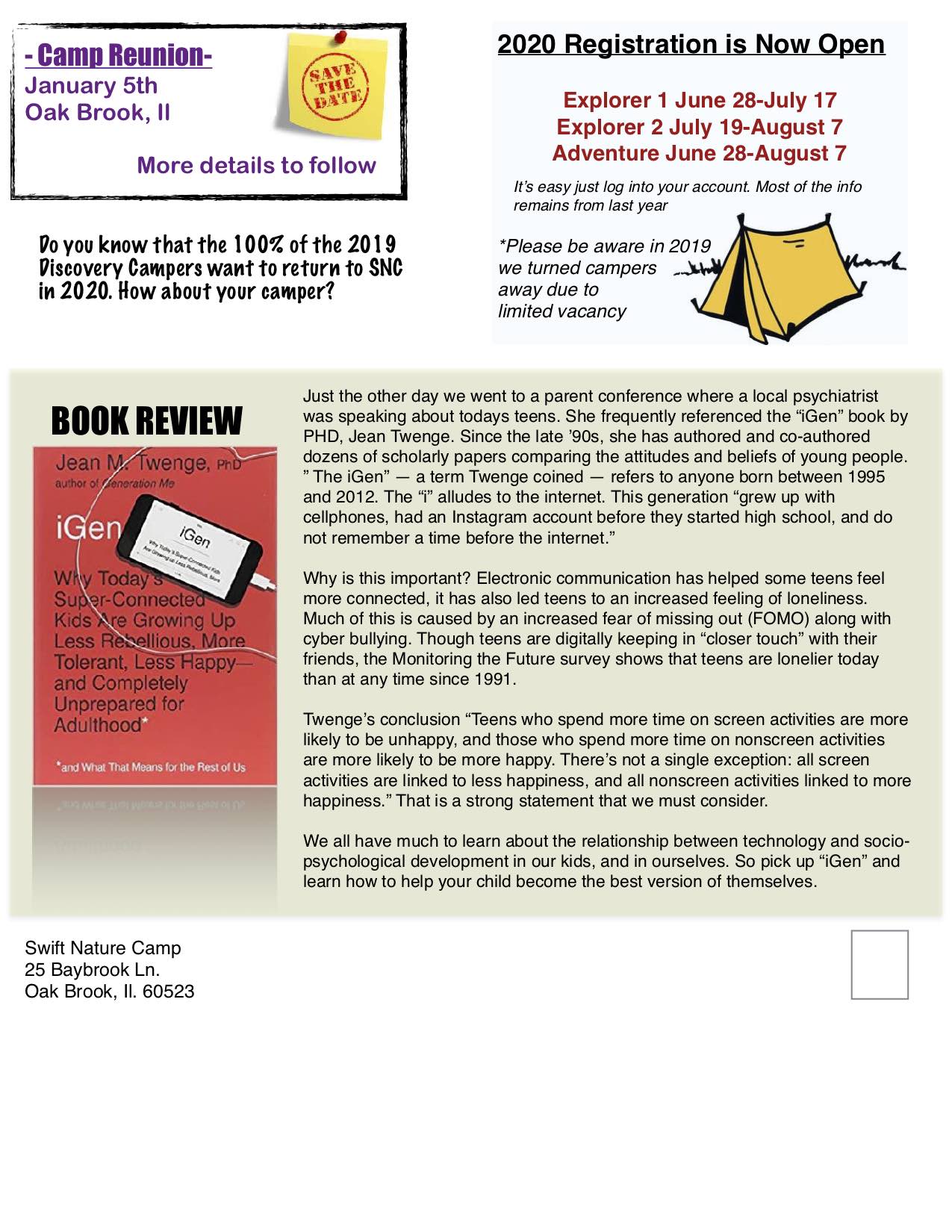
Recent Research  by  Harris Cooper, A university professor in association with the National Summer Learning Association, found that kids do forget information when school isn’t in session. “At best, students showed little or no academic growth over summer. At worst, students lost one to three months of learning,” the study reported.
 
For years teachers have noted that the beginning of the school year is a time to refresh the work that was done the previous year and that those students who recall the previous year more easily will do better at the current years studies. 
 
Recall when you were a kid—what was better than being a kid in the summer? For me I was one of those overnight summer camp kids so I recall the warm breeze on the lake, making leather crafts, playing capture the flag, and making new friends. Traditional Summer camps do provide children with fun learning opportunities that engage their brain and can lead to academic success when classes resume in September. 
 
Parents should look for opportunities to keep your child engaged and learning throughout the summer. This will allow them to continue building on their skills and foster their joy of learning.  It is important for parents to keep this goal in mind when picking a summer camp program. Selecting a summer camp that  immerses campers in experiential learning opportunities is a good choice. At Swift Nature Camp we provide just such an environment. 
 
At SNC we work with children not in memorizing facts about science and nature but on the process. We create an atmosphere were children have fun and want to learn.  When we guide them through the process, instead of simply giving them answers we fosters creativity, giving children skills to be critical thinkers and develop their own solutions to a problem.
 
The benefits of Experiential learning start at self-discovery by giving the children the tools to complete a task at hand, but leaves the steps to complete the task up to them. Children learn better and find more joy in learning when they do it themselves. When campers do this they better remember te experience.
In addition to learning traditional camp activities along with science campers build upon the social and emotional skills. Communal living helps children become more sensitive and caring toward others. Teamwork is what happens everyday at Swift Nature Camp.
 
Many of SNC parent avail themselves to the tutoring program offered. This program is more of a refresher class that keeps children "where they are" rather than teaching new concepts,  slowing down the learning loss that happens during the summer. Maybe it might be an option to consider this summer.
ACA Accreditation means that the summer camp you are considering has voluntarily agreed to undergo a thorough review of over 300 standards &emdash; from safety procedures to staff trainning and qualifications. The American Camp Association does not stand alone but works with experts from The American Academy of Pediatrics, the American Red Cross, and other youth service agencies to assure that current practices at that summer camp reflect the most up-to-date, research-based standards in camp operation. Camps and the ACA form a partnership that promotes summers of growth and fun in an environment committed to child safety. Bottom line, when you send your child to a summer camp that is ACA accreditied you know the owners and directors are doing everything possible to provide a safe and positve growing experience for your child.

ACA works with accredited camps to provide:

 
* Healthy, developmentally-appropriate activities and learning experience
* Caring, competent role models
* Service to the community and the environment
* Discovery through experiential education
* Opportunities for leadership and personal growth

What are some of the 300 ACA standards ?

 
* Staff to camper ratios are appropriate for different age groups
* Goals for camp activities are developmentally based
* Emergency transportation available at all times
* First-aid facilities and trained staff available

What's the difference between state licensing of camps and accreditation by ACA?


Accreditation is voluntary and ACA accreditation assures families that camps have made the commitment to a safe, nurturing environment for their children. Licensing is mandatory and requirements vary from state to state. ACA standards are recognized by courts of law and government regulators as the standards of the camp community.

How do ACA standards exceed state licensing requirements?


ACA goes beyond basic requirements for health, cleanliness, and food service into specific areas of programming, including camp staff from director through counselors, emergency management plans, health care, and management. ACA applies separate standards for activities such as waterfront, horseback riding, and adventure and travel.

How can I verify that my child's camp is ACA accredited?


Look for the ACA logo on camp website. Visit the ACA website at
www.ACAcamps.org or by calling 1-800-428-CAMP.
To learn more about how to choose a summer camp visit www.summercampadvisor.com

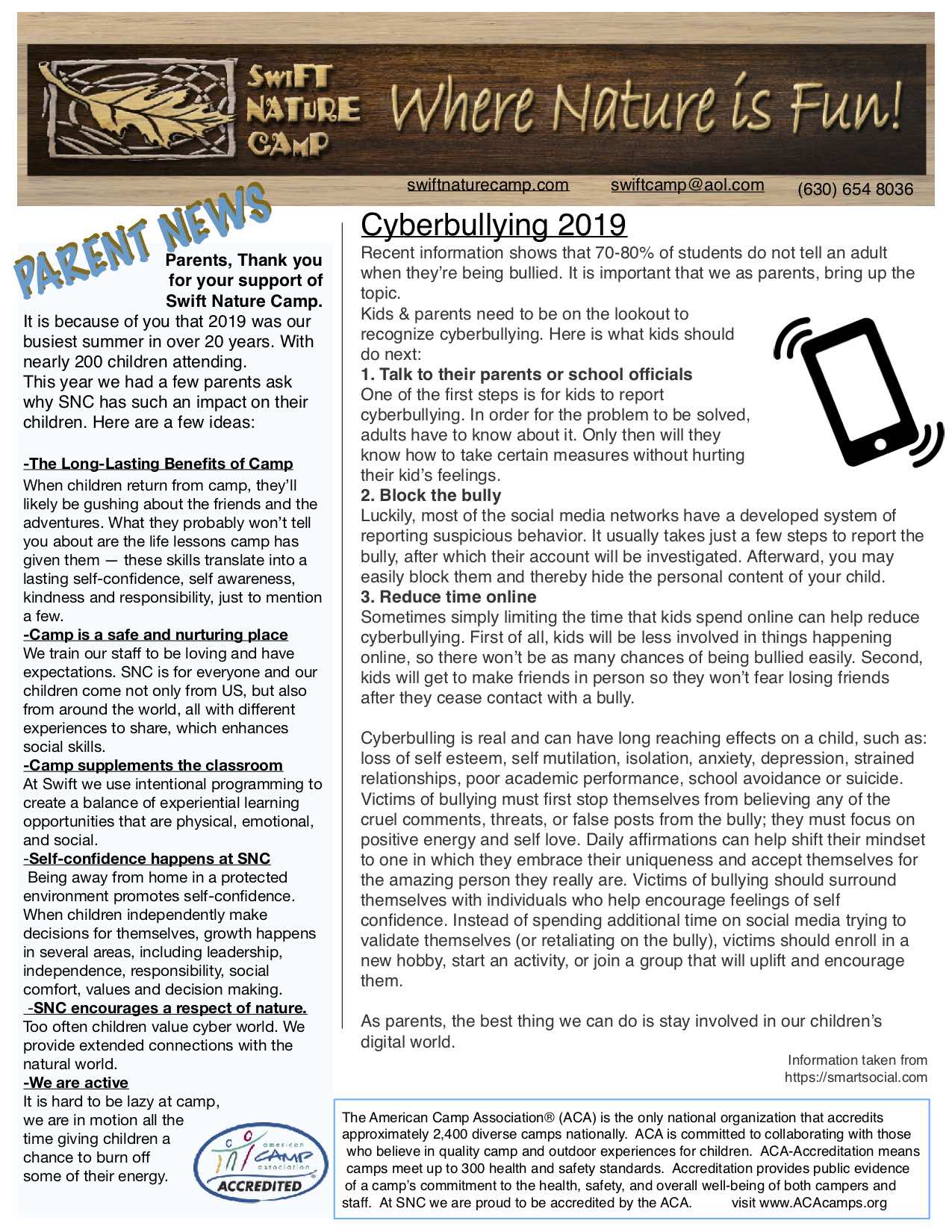
Camp benefits

Directions - View the full report (PDF - 2.8MB)

Between 2001 and 2004 the American Camp Association conducted national research with over 5000 families from 80 ACA-Accredited camps to determine the outcomes of the camp experience as expressed by parents and children.
Parents, camp staff, and children reported significant growth in:
  • Self-esteem
  • Peer relationships
  • Independence
  • Adventure and exploration
  • Leadership
  • Environmental awareness
  • Friendship skills
  • Values and decisions
  • Social comfort
  • Spirituality
The findings from this national study indicated that camp is a unique educational institution and a positive force in youth development. The camp experience can benefit children by increasing:
  • confidence and self-esteem
  • social skills and making friends
  • independence and leadership qualities
  • willingness to try and adventurousness
  • spiritual growth, especially at camps focused on spirituality.
No differences were found based on the camp type (day, resident) or session length.
For more information on the actual instrumentation, please visit the Camper Growth Index site where details about the instrumentation developed and used in the ACA National Outcomes Study are discussed. Free access to the instruments are also described along with the access process.
Page 23 of 84

Winter

25 Baybrook Ln.

Oak Brook, IL 60523

Phone: 630-654-8036

swiftcamp@aol.com

Camp

W7471 Ernie Swift Rd.

Minong, WI 54859

Phone: 715-466-5666

swiftcamp@aol.com